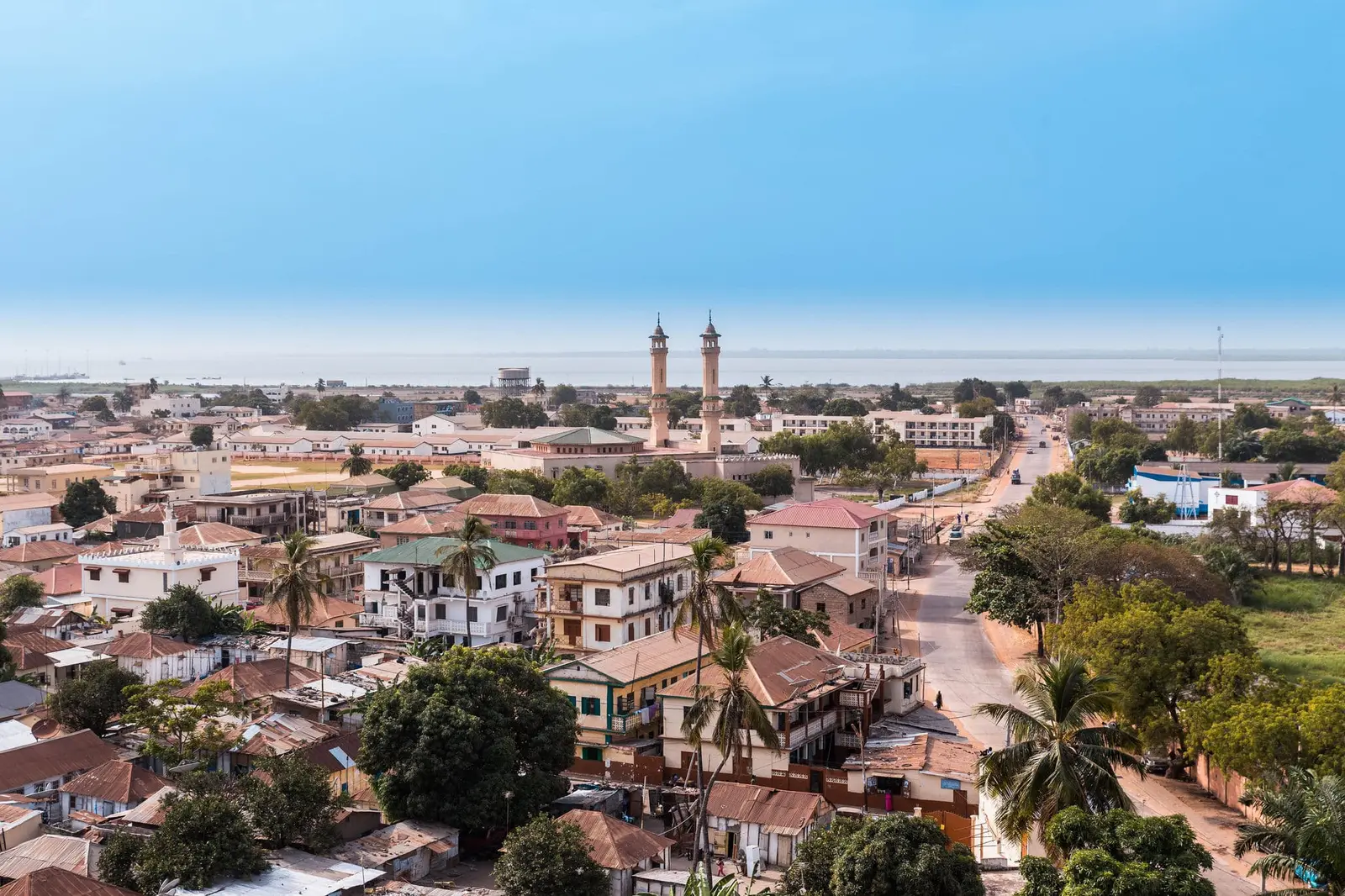
Banjul, Gambia
No cruise ships are scheduled in Banjul today, Monday 16 November 2026. The next is Amera on Thursday 31 December. Over the next 12 months, 6 calls bring about 4,500 passengers; the busiest day is Monday 22 February 2027, with 2 ships.
Ship schedule
Next 8 calls · all times local (Greenwich Mean Time)
Showing all 8 upcoming calls
Cruise Ships in Banjul
Today and the next 7 days · all times local (Greenwich Mean Time)
Next 7 days
- Mon16 Nov–No ships0 ships
- Tue17 Nov–No ships0 ships
- Wed18 Nov–No ships0 ships
- Thu19 Nov–No ships0 ships
- Fri20 Nov–No ships0 ships
- Sat21 Nov–No ships0 ships
- Sun22 Nov–No ships0 ships
Thousands of people in port, guests plus crew. Crowd level compared with a typical Banjul day.
Planning a day in Banjul?
The crowd calendar shows every ship and how busy the port is, hour by hour, plus the quietest and busiest days for the next 90 days.
Getting to the Banjul cruise port
Albert Market, Banjul → Port of Banjul
1.5 km · ~21 min by car
The main market sits in the heart of the small capital, a short distance north of the port, a walk of about 1.5 km, 21 minutes.
Typical prices, approximate. Fares change with demand, traffic and time of day.
Typical prices, approximate. Fares change with demand, traffic and time of day.
Driving to the port
The port is on the edge of the compact city centre, so the market and the main sights can be reached on foot, although the heat makes the walk tiring at midday. Taxis can be found in town; agree the fare first. Trips to the beaches, creeks and nature reserves outside the city need a ship tour, a taxi or a private driver.
Eating in Banjul
The currency is the Gambian dalasi. A dish to try is domoda, a rich peanut stew with meat and vegetables, and fresh local fish such as ladyfish.
Where to eat
Albert Market area
The streets around the main market, a short walk from the port, have simple local eateries and stalls selling fresh fruit and snacks among the fabric and craft sellers.
About Banjul
Banjul is the capital of The Gambia, set on St Mary's Island where the Gambia River meets the Atlantic Ocean. Although it is the seat of government, it is one of the smallest capitals in Africa and keeps a relaxed, village-like feel.
The compact old town has colonial-era buildings around MacCarthy Square, the twin minarets of the King Fahad Mosque and the landmark Arch 22. Albert Market, founded in the mid-19th century, is busy with stalls selling carvings, bright fabrics, fruit and vegetables.
Beyond the city, day trips lead to beaches on the Atlantic coast, mangrove creeks off the river, nature reserves known for birdwatching, and Kunta Kinteh Island, a UNESCO World Heritage site linked to the history of the slave trade.
- Climate
- Tropical, with a long dry season and a short rainy season. At the national weather station at Yundum, near the airport, November to May is almost completely dry, with afternoons of about 33 to 35 C. Nights are coolest from December to March, at about 17 to 19 C. The rainy season runs from June to October and peaks in August, when rain falls on about 18 days. Banjul itself gets about 840 mm of rain a year, with about 300 mm in August alone. Wet-season afternoons are a little cooler, at about 31 to 32 C, but nights stay warm at about 23 to 24 C. All figures are approximate.
- Time zone
- Greenwich Mean Time
- Currency
- Gambian Dalasi (GMD)