
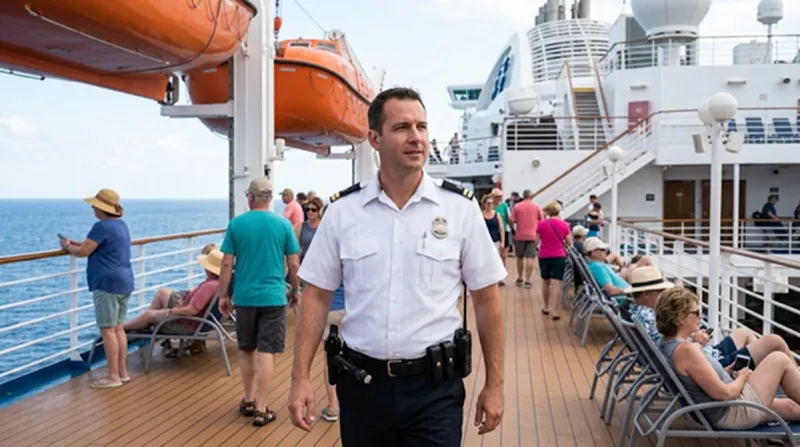
The U.S. Department of Transportation logged 50 reported crimes across all cruise lines in the second quarter of 2026, and that count covers only incidents involving U.S. nationals. Each file began with someone taking a statement in a small office below deck.
Cruise ship security blends airport screening, hotel detective work and maritime enforcement, all under shifting jurisdictions, with a crew speaking dozens of languages and no police station for 200 miles.
Add gangway queues, intoxicated guests, stolen passports and the occasional overboard alarm, and the shift rarely runs to plan. Before scanning cruise ship itineraries for your next sailing, it helps to see how that day unfolds.
Embarkation Day Starts Before Sunrise
Turnaround day begins around 5 a.m., long before the first suitcase reaches the ramp. The officer meets port authorities, completes the Declaration of Security required under the ISPS Code, and sets the gangway plan: who screens, who relieves whom, where the visitor pass log lives.
Master keys are counted. X-ray machines get calibrated and tested. Shell door sentries, usually crew borrowed from other departments, get a refresher on what they can and cannot wave through.
By the time 3,000 guests arrive inside a two-hour window, the officer is mostly managing flow. One failed scanner at a homeport like Southampton cruise port can back a queue out into the terminal car park, and published port schedules leave very little slack for a late departure.
What Goes Through the X-Ray Machine
So what gets pulled out of bags most often? Rarely anything dramatic. Screening exists to stop dangerous and prohibited items reaching the vessel, and the officer's task is applying the rule without turning hour one of a holiday into an argument.
Frequent finds include:
- Power strips with surge protection, a known cabin fire risk
- Irons, kettles, candles and hot plates
- Alcohol over the line's allowance, often held and returned the final night
- Drones, restricted by many ports and flag states
- Knives, tools and anything resembling a weapon
Most guests hand items over without fuss. A few argue, and the exchange gets logged either way, because a calm note written at noon can matter if the same name resurfaces at 2 a.m.
Patrols and the Camera Room
Once the ship sails, the rhythm changes. Staff patrol loops covering restricted, controlled and vulnerable areas: bridge, engine control room, provision stores, crew corridors. A colleague works the CCTV wall.
Large ships can carry well over a thousand cameras, and nobody watches all of them at once. The camera room earns its keep afterwards, when an officer rebuilds a timeline of who went where.
Night rounds fold safety into the same walk, with a detailed log kept for the security officer to review. Propped fire doors, blocked exits, guests asleep on windy loungers. Officers also enforce the master's rules and regulations, covering everything from balcony smoking to crew conduct. The work is repetitive by design, and that repetition is the whole point.
The Radio Never Stops
Ship radios run on UHF, tuned to a hull of steel decks and fire zones. They work well inside that envelope and stop working outside it, which is the reason gangway teams sometimes lose contact with staff who walk into a terminal basement or a coach park.
Shoreside operations tend to solve the problem with a different technology altogether. Push-to-talk over cellular sends voice across LTE networks rather than dedicated frequencies, so range depends on carrier coverage instead of repeater placement.
Peak PTT is one of the vendors in that category, and its documentation describes radios certified on major U.S. carriers with talk groups configured before shipping. The trade-off is straightforward: coverage extends wherever a signal exists, and disappears once the ship leaves the coast. Officers alongside a pier therefore work across two systems.
When Guests Start Swinging
With a record 37.2 million people cruising in 2025, even a low incident rate produces a steady flow of altercations. Most share a pattern: late hour, open bar, small dispute over a lounger or a spilled drink.
Response usually follows a set path:
- Separate the parties and move them out of public view
- Take statements, pull footage, photograph injuries
- Confine the aggressor to a cabin, or occasionally the brig
- Brief the master, who decides on disembarkation at the next port
One Royal Caribbean guest confined after a March 2026 incident on Liberty of the Seas described her room stripped of cables, desk chair, shower curtain and showerhead, with room service her only source of food.
Theft, Missing Guests and Small Investigations
Ever wondered who chases down the guest who missed all-aboard? Missing phones, wallets left in bars, a teenager who stopped replying to messages: these fill more hours than fights do. Officers can trace key card swipes, pull stairwell footage and page a guest through the PA before anyone starts panicking.
Shore days add their own category. When guests miss the sailing time, security works with the port agent on passports, luggage and onward travel to the next call. At a short stop like Ensenada cruise port, a couple of late returns each week can be routine.
Handling incidents involving theft or missing persons sits squarely in the role description, and both can consume an afternoon.
Port Days Change the Rules
Jurisdiction shifts every time the ship ties up. An incident at sea may fall to the flag state and, for U.S.-linked sailings, the FBI. The same incident alongside a pier belongs to local police, and local law catches people out.
Camouflage clothing is illegal in the Bahamas and several other cruise destinations, though guests are often escorted back to change rather than arrested.
Officers spend port days as liaisons: meeting local police, handing over statements, escorting guests ashore when ordered. In June 2026, five American passengers were arrested after a fight at Nassau cruise port, with charges including assaulting a police officer and resisting arrest. Busy calls such as Philipsburg cruise port can host several ships at once, multiplying the odds.
Code Oscar After Midnight
The call nobody wants arrives as a code word. On Norwegian Breakaway in April 2026, guests reported a "Code Oscar, port side" announcement shortly after midnight, with portions of Decks 7 and 8 closed while a Coast Guard helicopter and Provincetown crews searched.
Response is drilled hard: mark the position, deploy a lifebuoy, begin the turn, launch the rescue craft, account for everyone aboard. Searches can stretch on. Carnival Splendor spent 16 hours searching off Brisbane that same month.
Detection speed decides most outcomes, which is why onboard systems matter so much. A father and daughter were rescued in 19 minutes thanks to the overboard detection system on Disney Dream.
The Reports Nobody Reads
Every incident generates paperwork: a security log entry, an event report, witness statements, a footage export, and sometimes a submission that eventually feeds federal crime data. Officers also deliver security familiarisation to crew, perform frequent security assessments and revise the Ship Security Plan.
Contracts often run around six months, with long shifts and no days off. Many officers arrive from military or police backgrounds, which can explain the composure guests occasionally read as coldness.
Underneath that composure sits a filing habit, because a rushed statement written at sea can fall apart months later in a courtroom ashore. If the report is thin, the case usually is too.
What Cruisers Rarely See From Deck 15
The job looks little like the brochure version. Most of it is queue management, log entries, footage reviews and conversations with people having a rough night. The dramatic parts arrive without warning and finish in a stack of forms.
If you sail often, you may never speak to a security officer beyond a nod at the gangway, and that would count as a good result for both of you. Still, understanding the machinery can change how you read a closed deck, a delayed departure, or a crew member posted outside a cabin door. Someone judged it necessary, and they almost certainly wrote it down.